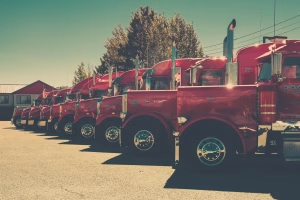
If you run a transport or logistics fleet in South Africa, diesel is almost certainly your single largest controllable cost. For most fleets, fuel makes up 35% to 55% of total operating costs — and in 2026 that number is under more pressure than ever.
Choosing the right fuel monitoring system in South Africa is no longer a “nice to have.” It’s the difference between a fleet that protects its margin and one that quietly bleeds profit, one tank at a time. But with probes, sensors, GPS units, AI dashboards and dozens of suppliers all promising the same thing, how do you actually choose?
This guide breaks down exactly what to look for, the questions to ask every supplier, and how to make sure the system you buy pays for itself.
Why fuel monitoring matters more than ever in 2026
A few realities every South African fleet owner is living with right now:
- Diesel is expensive and volatile. Wholesale 50ppm diesel sits at roughly R31.44 per litre as of June 2026, and prices swing every month. A single increase can wipe out a thin margin overnight.
- Fuel theft is widespread. Industry data suggests around 73% of fleets experience fuel theft, and a large share of it is internal — drivers, depots, or collusion at the pump.
- The losses are real money. At current diesel prices, a single truck can lose well over R60,000 a year to theft and waste. A 10-truck fleet can quietly lose R600,000+ per year.
You cannot manage what you cannot measure. A proper fuel monitoring system turns diesel from a guess into a number you can trust.
The 8 things to look for in a fuel monitoring system
Use this as your checklist when comparing suppliers.
- High-accuracy fuel probes (not just flow meters)
The heart of any serious system is a high-precision fuel probe installed in the tank, measuring the actual level of diesel — not an estimate. Ask suppliers for their stated accuracy. A quality probe should detect fills, drops, and siphoning events down to a few litres. SmartMix probes, for example, are built for detection of theft events with up to 95% probability accuracy.
Tip: Be cautious of systems that rely only on the vehicle’s factory fuel gauge or CAN-bus reading. They’re convenient but rarely accurate enough to prove theft.
- Real-time alerts, not next-day reports
The best time to catch a 200-litre drop is the moment it happens — not in a report you read next week. Look for live alerts (SMS, app, or dashboard) for sudden fuel drops, after-hours activity, and short-fills at the pump.
- Theft and siphoning detection
Make sure the system specifically flags:
- Sudden fuel drops while the vehicle is stationary or off
- Short-fills (you paid for 500L, only 430L went in)
- After-hours refuelling or dispensing
- “Ghost” kilometres and phantom fills that don’t match consumption
- Fuel efficiency reporting (km per litre)
Theft is only half the story. A good system tracks consumption per vehicle and per driver so you can spot the trucks burning more than they should — whether that’s idling, route inefficiency, or mechanical issues.
- GPS and fleet integration
Fuel data is far more powerful when tied to location and movement. Look for a system that combines fuel monitoring with GPS tracking so every fill and drop is mapped to a place, time, and trip. Ideally it integrates with your existing fleet management and tracking.
- AI-powered analysis and a single dashboard
Raw data overwhelms; insight saves money. Modern systems use AI to flag anomalies automatically and surface only what matters. Ask whether the supplier offers a centralised dashboard across your whole fleet and depots, plus investigation reports you can act on.
- Coverage for your whole operation
A transport fleet rarely runs trucks alone. Check that the supplier can also monitor bulk storage tanks (ATG), diesel bowsers, generators, and LDVs/bakkies — so you have one provider and one system across every litre, from depot to truck.
- Local support, installation and finance
This is where many fleets get burned. Ask:
- Do you have technicians in my province for installation and repairs?
- What’s the warranty and response time?
- Are devices VESA-approved and is the company PSIRA-registered?
- Can the system be financed monthly rather than paid upfront?
SmartMix, for instance, is based in Bloemfontein with technicians in every province, fits VESA-approved devices, and offers finance options to spread the cost.
Questions to ask every supplier before you sign
- What is your probe’s measurement accuracy, and how do you prove a theft event?
- Do I get real-time alerts, and through which channels?
- Can you show me a real investigation report from another fleet?
- What’s the total cost — hardware, installation, monthly software, and data?
- What is the typical payback period for a fleet my size?
- Who installs and services the units, and how fast can you reach my trucks?
- Does the system also help me claim my diesel rebate with accurate records?
That last point matters: accurate, automated fuel records don’t just stop theft — they make SARS diesel rebate claims far easier to substantiate.
How to calculate whether it’s worth it
A simple way to sanity-check any quote:
Estimated annual saving = (litres lost per month to theft + waste) × diesel price × 12
Even a conservative recovery of 5–10% of your fuel spend usually covers the cost of the system several times over. If a supplier can’t help you build this business case, that’s a red flag. A good fuel partner sells outcomes (litres protected, rands saved), not just hardware.
Why fleets choose SmartMix Technologies
SmartMix Technologies has spent over 15 years building South Africa’s fuel-intelligence ecosystem specifically for local conditions. Fleets choose SmartMix because the system delivers:
- High-precision fuel probes with up to 95% theft-detection accuracy
- Real-time alerts for theft, short-fills, and after-hours activity
- AI-powered reporting that turns raw data into clear action
- Full coverage — trucks, LDVs, bowsers, generators and bulk ATG tanks
- Diesel consumption savings of 5–25% for typical fleets
- Nationwide installation and support, with VESA-approved, PSIRA-backed service
- Monthly finance options so the system pays for itself as it protects you
The goal is simple: every drop measured, every litre protected.
Ready to protect every litre?
If diesel is eating your margin, the first step is knowing exactly where it’s going. Book a no-obligation fuel assessment with SmartMix Technologies and we’ll show you where your fleet is losing fuel — and what it’s costing you.
Contact SmartMix Technologies today or explore our 360 Fuel Management Solutions, Fuel Probes, and Finance Options.
Frequently Asked Questions (add as FAQ schema for rich results)
How much does a fuel monitoring system cost in South Africa? Cost depends on fleet size, the type of probe, and whether you add GPS and AI reporting. Most fleets recover the cost quickly through reduced theft and waste, and providers like SmartMix offer monthly finance so there’s no large upfront outlay.
Can a fuel monitoring system actually detect diesel theft? Yes. A high-precision fuel probe detects sudden fuel drops, short-fills, and siphoning — often with up to 95% probability accuracy — and sends real-time alerts the moment they happen.
Will fuel monitoring help with my SARS diesel rebate? Accurate, automated fuel records make it far easier to substantiate diesel rebate claims, reducing both the admin burden and the risk of a rejected claim.
Does it work on bakkies, generators and bulk tanks too? Yes. A complete system can monitor trucks, LDVs/bakkies, diesel bowsers, generators, and bulk storage tanks (ATG) — all from one dashboard.
SmartMix Technologies — Bloemfontein, serving fleets country-wide. Every Drop Protected. Every Litre Accounted For.