Industry Insights | SmartMix Technologies
South Africa’s road freight industry is facing increasing financial pressure. Rising logistics expenditure, fuel-price volatility, infrastructure challenges and growing operational costs are placing transport businesses under pressure to protect their margins while maintaining reliable service delivery.
According to the GAIN Group’s State of Logistics 2026 report, South Africa’s national logistics expenditure is forecast to reach approximately R1.156 trillion in 2026, equivalent to 14.6% of the country’s GDP.
One statistic deserves particular attention from every transport operator: Fuel accounted for an estimated 43.4% of South African road freight expenditure in 2025.
The report also forecasts aggregate road freight fuel expenditure to increase from approximately R188 billion in 2025 to R274 billion in 2026.
These figures highlight a fundamental reality: fuel is not simply another operating expense. It is one of the largest financial variables influencing the profitability and sustainability of transport businesses.
For fleet owners and management teams, the question is no longer just how much diesel is being purchased. It is whether every litre can be accounted for, monitored and managed effectively.
1. The Changing Economics of South African Road Freight
The South African logistics industry is an essential part of the country’s economy, connecting manufacturers, suppliers, retailers, mining operations, agricultural producers and consumers.
However, the cost of moving goods continues to increase.
The GAIN Group’s 2026 research identifies transport as the largest component of national logistics expenditure, accounting for approximately R683 billion of the projected R1.156 trillion logistics bill.
Several factors contribute to this pressure:
- Increasing diesel expenditure and fuel-price volatility.
- Driver wages and employment-related costs.
- Vehicle depreciation and financing.
- Tyres, maintenance and repairs.
- Insurance, licensing and toll expenses.
- Longer transport distances and operational inefficiencies.
Although businesses cannot control every external cost, they can improve how effectively they manage the resources within their operations.
Fuel management is one of the most important areas where better information and operational discipline can make a difference.
2. Fuel Is One of the Biggest Controllable Fleet Expenses
When fuel represents approximately 43.4% of road freight expenditure, even relatively small inefficiencies can have a meaningful financial impact.
Consider a transport company operating 100 trucks.
If each truck consumes 3,000 litres of diesel per month, the fleet uses:
– 300,000 litres per month.
– 3.6 million litres per year.
At an illustrative diesel cost of R20 per litre, this represents R6 million in monthly fuel expenditure and R72 million annually.
Now consider the financial implications of a small percentage of unaccounted-for fuel.
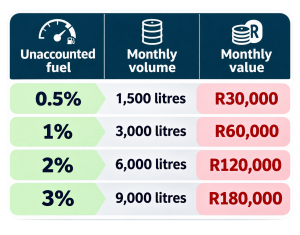
Illustration based on 100 trucks, each consuming 3,000 litres monthly, at R20 per litre. These percentages are hypothetical scenarios, not industry-average theft rates or guaranteed savings.
At a 2% discrepancy, the potential exposure amounts to R1.44 million annually.
This illustrates why fuel accountability should form part of every fleet’s financial management strategy.
A business cannot effectively manage what it cannot accurately measure.
3. The Hidden Cost of Poor Fuel Visibility
Fuel losses are not always the result of obvious theft. In many operations, financial discrepancies develop gradually through a combination of operational inefficiencies, inaccurate reporting and limited visibility.
Common challenges include:
- Unauthorised fuel removal
- Diesel can be removed from a vehicle’s tank without management immediately becoming aware of the incident.
- Unexplained fuel consumption
- Unexpected changes in fuel consumption can indicate operational problems, excessive idling, inefficient driving practices or possible fuel losses.
- Refuelling discrepancies
- The quantity of diesel recorded during refuelling may not always correspond with the actual increase in the vehicle’s fuel tank.
- Limited after-hours visibility
- Vehicles frequently park overnight at depots, customer premises and other locations. Without continuous fuel-level monitoring, unexpected fuel losses may only be discovered during the next manual inspection.
- Inaccurate fuel reporting
- When management relies on manual readings, fuel slips and periodic reconciliations, identifying exactly when and where discrepancies occurred becomes difficult.
The financial impact extends beyond the cost of missing diesel. It can also affect vehicle availability, operational planning, driver accountability and the reliability of management reporting.
4. Why Traditional Fuel Management Is No Longer Enough
Many transport businesses already use fuel cards, GPS tracking platforms and manual fuel reconciliation processes.
These systems provide valuable information, but each serves a different purpose.
Fuel cards record fuel purchases and transactions. GPS tracking provides vehicle location and movement information. Manual dip readings provide occasional snapshots of tank levels.
However, these methods do not necessarily provide continuous, accurate visibility of what is happening inside a vehicle’s fuel tank.
For example:
- A fuel transaction confirms that diesel was purchased, but not necessarily how much entered the vehicle’s tank.
- GPS tracking identifies where a vehicle is located, but does not independently confirm its actual fuel level.
- A manual dip reading provides a measurement at a particular moment, but cannot reliably identify every event between inspections.
This is where real-time fuel monitoring becomes important.
By combining fuel-level information with vehicle location, time-based data and operational reporting, businesses can move beyond traditional fuel administration towards more comprehensive fuel intelligence.
5. Moving From Fuel Monitoring to Fuel Intelligence
Modern fleet management should focus on more than collecting information. It should turn operational data into meaningful intelligence that supports better decisions.
Real-time fuel monitoring provides management with greater visibility into the movement and consumption of diesel across their fleets.
A properly configured fuel monitoring solution can help identify:
– Unexpected fuel-level drops.
– Refuelling events and quantities.
– Abnormal fuel consumption patterns.
– Potential unauthorised fuel removal.
– Vehicle idling and operational inefficiencies.
– Differences between expected and actual fuel usage.
When this information is combined with GPS positioning and historical reporting, fleet managers gain a clearer understanding of what is happening across their operations.
The objective is to identify irregularities earlier, investigate discrepancies and make decisions based on reliable information rather than assumptions.
Fuel intelligence also supports a more accountable operating environment, where management can evaluate fuel performance at vehicle, driver, route and fleet level.
6. Turning Operational Data Into Better Business Decisions
The real value of fleet technology is not simply the amount of information it collects. Its value lies in how effectively businesses use that information.
Accurate fuel data can support several important management decisions.
- Financial management
- More accurate fuel reporting allows finance teams to compare fuel expenditure against actual consumption and investigate discrepancies.
- Operational efficiency
- Consumption trends can help identify vehicles or operating patterns that require attention.
- Asset protection
- Unexpected fuel-level changes can trigger alerts that allow management or control-room personnel to investigate potential fuel losses.
- Fleet accountability
- Vehicle-level reporting creates greater transparency and supports more informed discussions about fuel usage and operational performance.
- Strategic planning
- Historical fuel data can help businesses evaluate vehicle performance, operational costs and opportunities for improvement.
For larger transport operations, the ability to consolidate this information across hundreds or thousands of vehicles becomes increasingly important.
Fuel intelligence should therefore be viewed as part of a broader fleet-management and business-intelligence strategy.
7. How SmartMix Technologies Helps Businesses Take Control
At SmartMix Technologies, we believe effective fuel management starts with accurate information.
We provide fuel monitoring and fleet visibility solutions designed to help businesses gain greater control over diesel consumption, fuel security and vehicle operations.
Our solutions combine high-precision fuel monitoring equipment with communications technology, GPS tracking and reporting capabilities to provide businesses with greater visibility into their assets.
Our technology includes:
- High-precision fuel probes
- Fuel probes measure actual fuel levels inside vehicle tanks, providing more detailed information than relying solely on dashboard fuel gauges or manual readings.
- Real-time fuel monitoring
- Monitor fuel-level movements and consumption patterns through connected monitoring systems.
- Fuel theft detection
- Identify unexpected fuel-level drops and receive alerts that can assist management and control-room teams in investigating potential diesel theft.
- Refuelling monitoring
- Record fuel-level increases and monitor refuelling activity to support more effective fuel reconciliation.
- Fleet visibility
- Combine fuel information with vehicle positioning and operational data to provide a more comprehensive view of fleet activity.
- Control-room intelligence
- Give monitoring teams access to relevant information to investigate irregularities, identify potential risks and support operational intervention.
SmartMix Technologies serves businesses across industries including:
– Road transport and logistics.
– Mining and earthmoving.
– Construction and infrastructure.
– Agriculture and farming.
– Refrigerated transport and fleet operations.
Whether a business operates a small fleet or manages hundreds of commercial vehicles and heavy-duty assets, having accurate fuel information can make a meaningful difference to operational control.
Our objective is to help businesses move away from reactive fuel management towards a more proactive, data-driven approach.
8. The Future of Fleet Management Is Built on Better Intelligence
South Africa’s logistics industry will continue to evolve as businesses respond to changing transport costs, infrastructure developments, technology and increasing demands for operational efficiency.
As fleets become more connected, the ability to collect, analyse and act on accurate operational information will become increasingly important.
Artificial intelligence, advanced analytics, telematics and integrated monitoring platforms will continue to create opportunities for businesses to improve how they manage their assets.
However, meaningful intelligence starts with reliable data.
Without accurate fuel-level information, businesses are limited in their ability to understand consumption patterns, identify irregularities and measure fuel performance.
For transport operators, the future is not simply about knowing where their vehicles are.
It is about understanding how their assets operate, how resources are consumed and where opportunities exist to improve profitability.
Conclusion: Every Litre Matters
With fuel accounting for a substantial proportion of South African road freight expenditure, diesel management deserves the same level of attention as vehicle maintenance, financial management and operational performance.
Businesses cannot control international oil prices, exchange-rate movements or every external factor influencing transport costs.
They can, however, improve their visibility, strengthen fuel accountability and take a more proactive approach to managing diesel.
The difference between simply purchasing fuel and effectively managing fuel lies in the quality of information available to management.
At SmartMix Technologies, we believe every litre should be accounted for.
Through high-precision fuel monitoring, real-time visibility and intelligent reporting, we help businesses make better-informed decisions about one of their most significant operating expenses.
If your business wants greater visibility over diesel consumption, improved fuel security and better control of its fleet operations, SmartMix Technologies can help.
Take control of your fuel. Protect your assets. Make every litre count.
Contact SmartMix Technologies
Visit www.smartmixtechnologie.co.za to explore our fuel monitoring and fleet visibility solutions.
Contact our team to arrange a consultation and discover how real-time fuel intelligence can support your business.